
The chart holds the answer. Your reviewers shouldn't have to hunt for it.
ChartBridge turns a denial reason into ranked, cited chart evidence pulled from Epic and Oracle Health/Cerner, scoped to what the denial must prove, and ready for your reviewer to verify and export.
Built for medical necessity, level-of-care, and DRG downgrade denials. Reviewer judgment stays with the reviewer.
"If it's not documented in the chart, it never happened."
Your reviewers know the chart holds the proof. Getting it out is the job that eats the day:
A single case can mean searching a chart of 1,000+ pages.
A reviewer often forms the clinical judgment in minutes, then spends hours verifying each fact, finding the supporting documents, and printing, merging, and assembling the package.
Of the six steps between a denial reason and a finished evidence package, only one is clinical judgment. The other five are search, verification, and assembly.
Reviewers tell us the same thing: once the documentation is found, the rest of the appeal is the easy part. The evidence is the work, and that is the step ChartBridge takes off your reviewers' desks.
Sources: reviewer interviews, denial operations, Q1 2026.
The cost of proving a claim is rising faster than any team can hire.
Denial volume is climbing, and reviewer hours are your scarcest resource. The gap does not close by hiring. It closes by giving every reviewer the search, verification, and assembly work pre-done, so their time goes to the judgment calls only they can make.
$25.7B
what providers, including the hospital clients you answer to, spent in 2023 proving what the chart already contains (Premier national provider survey, 2023)
+23%
that spend's growth in a single year, while manual chart review stayed flat
70%
of denials ultimately overturned. The money was owed; it still took a full manual review to get it back
One workflow, from denial reason to cited export.
Five of the six manual steps, automated. The one that matters, clinical judgment, stays exactly where it belongs.
- 01
Denial reason in.
Start from what the payer says must be proven: medical necessity, level of care, or DRG downgrade.
- 02
Targeted retrieval.
ChartBridge pulls the relevant clinical documents and structured chart data from Epic and Oracle Health/Cerner over FHIR R4.
- 03
Ranked evidence.
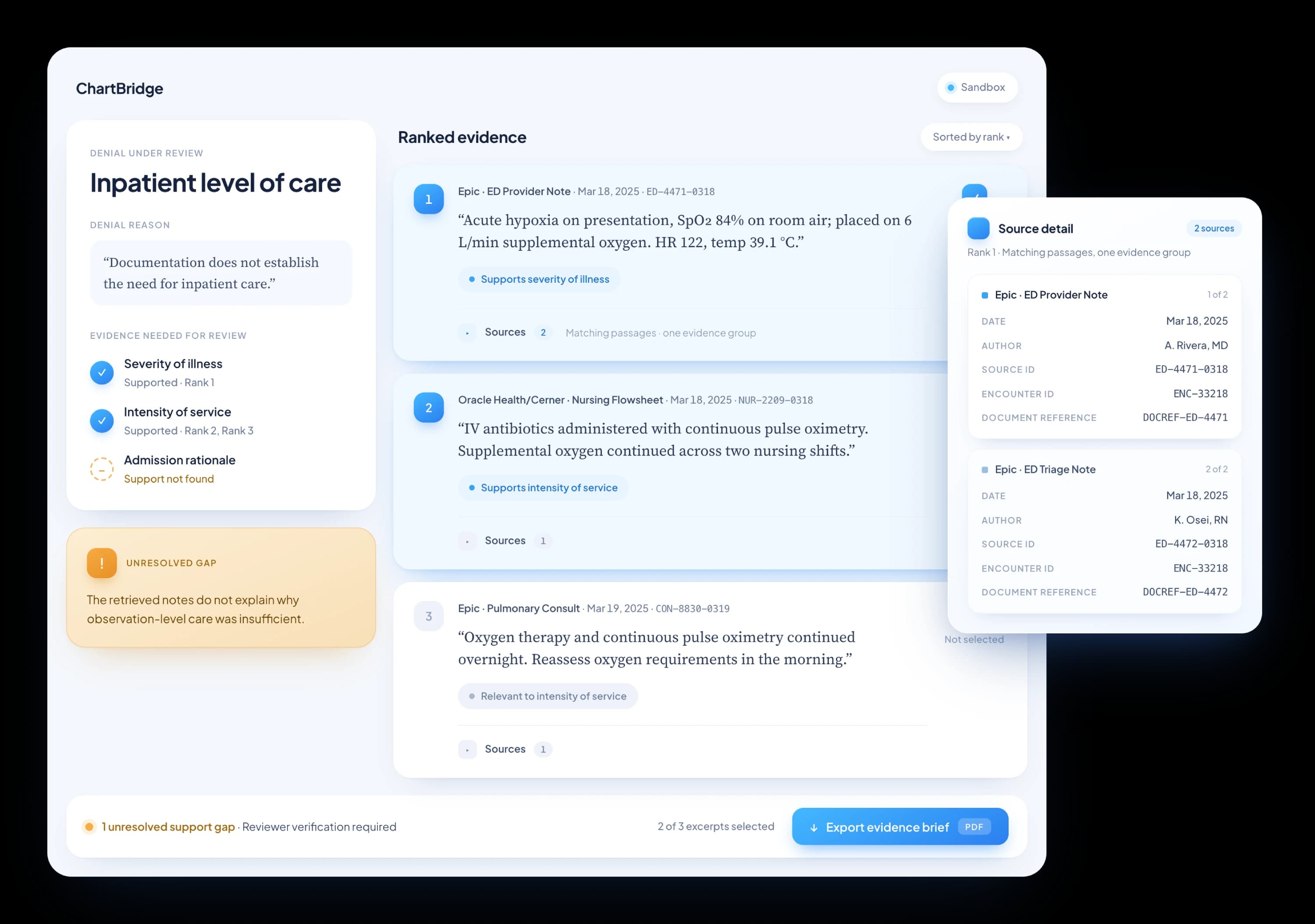
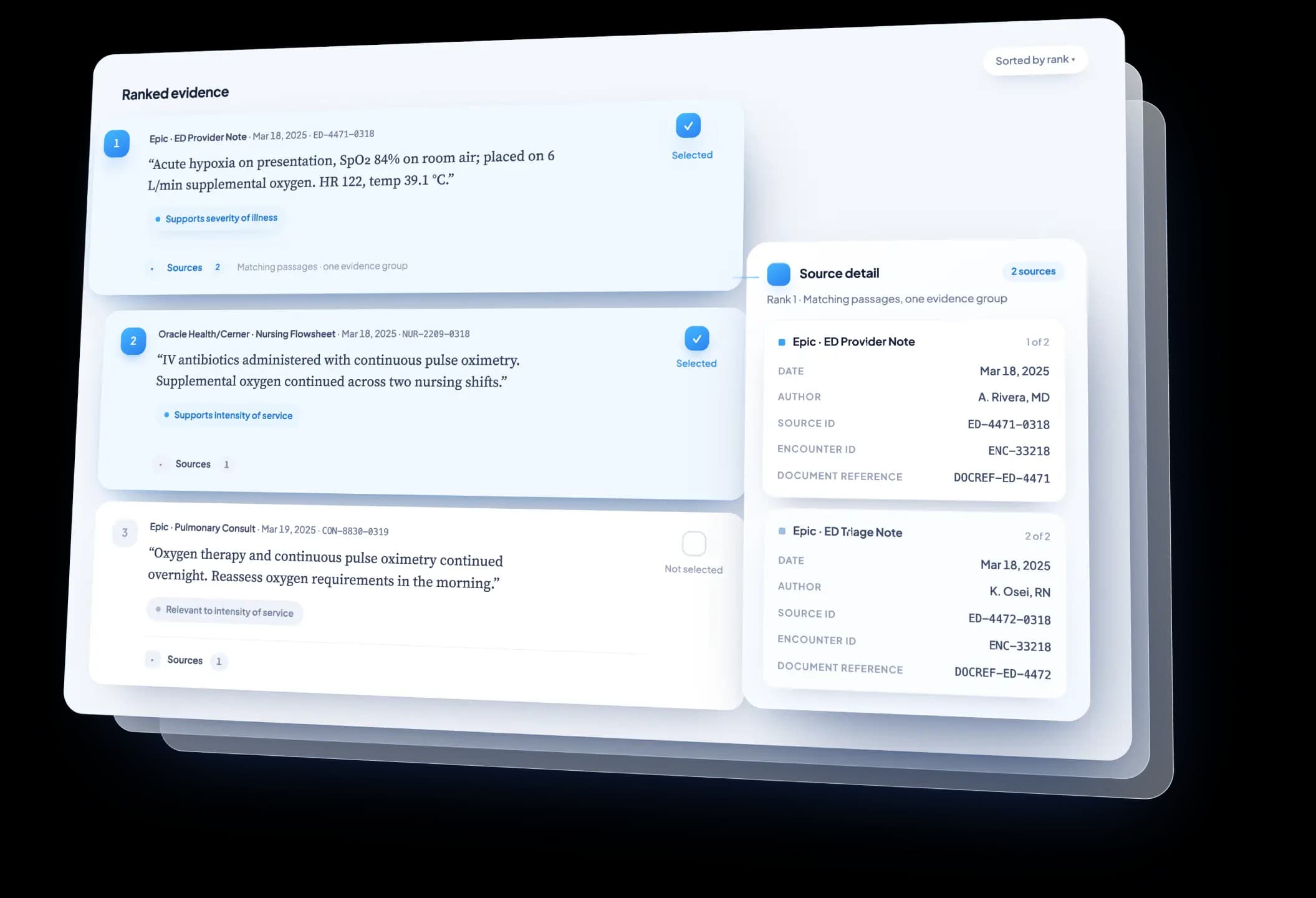
Denial-relevant excerpts are ranked against what the denial must prove, not returned as another 1,000-page PDF.
- 04
Visible gaps.
Missing support shows up beside the evidence, so weak cases surface before your team invests more hours in them.
- 05
Reviewer verification.
Every excerpt carries its note type, date, system, and source identifier. Your reviewer checks each one against the chart.
- 06
Cited export.
Only what the reviewer selects leaves the system as an assembled, cited evidence package. No printing, no merging.
Ranked, cited, and reviewer-controlled.
Scoped to the denial.
Passages are mapped to what the denial must prove, not to whatever a keyword search happens to hit.
Every source preserved.
Each excerpt keeps its system, note type, date, and source ID, so every selection is defensible to a payer, an auditor, or a client.
Gaps in plain sight.
Missing support is flagged beside the evidence, helping your team separate strong appeals from cases that should be closed early.
Nothing exports without the reviewer.
No excerpt leaves the system until a reviewer includes it. Black-box automation has no place in a clinical workflow.
When a hospital client asks why a case was appealed or closed, the cited evidence package is the answer, ready to share. Every outcome your team reports is one your clients can see the support for.
Epic and Cerner hold the chart. ChartBridge finds the denial evidence.
Epic and Oracle Health/Cerner remain your clinical sources of truth. ChartBridge doesn't replace them, compete with them, or ask your hospital clients to change anything. It adds the one view they don't have: the denial-specific evidence view, with live chart access instead of PDF review.
| Today, in the EHR | With ChartBridge |
|---|---|
| The reviewer interprets the denial reason | Evidence is mapped to what must be proven |
| Support is found by manual search | Denial-relevant excerpts are ranked |
| Missing support surfaces only on full review | Gaps show beside the evidence |
| Documents are printed and merged by hand | Reviewer-selected, cited evidence exports |
Deliberately narrow, by design.
ChartBridge does not:
- 01Replace the EHR or its system of record.
- 02Manage the full appeal end to end.
- 03Generate the appeal letter itself.
- 04Replace reviewer clinical judgment.
It is the evidence layer underneath all four, and your reviewer controls everything that leaves the system. Narrow scope is why it deploys fast and earns trust in a workflow where defensibility is everything.
Not a mockup. A working system.
one recorded cross-provider run, from evidence query to ranked, cited evidence ready for reviewer verification, against work that takes hours by hand.
(Epic and Oracle Health/Cerner FHIR R4 sandboxes; a single recorded result, not a benchmark distribution. Paid pilots establish median and p95 on your cases.)
Epic FHIR R4 retrieval and Oracle Health/Cerner retrieval on one provider-neutral path
Denial rules for medical necessity, level of care, and DRG downgrade
Ranked excerpts, structured facts, gap signals, citations, preview, and PDF export
A standalone Evidence API underneath it all, ready to embed in your own systems as you grow
We measure what you would measure.
ChartBridge pilots run against written acceptance criteria, agreed before the pilot starts:
- Median and p95 evidence-ready time, against your manual baseline
- Evidence relevance and citation accuracy
- Reviewer verification and assembly effort
- Case turnaround
The ROI case gets built on your numbers, not ours. If the workflow doesn't move your recoveries, your timeliness, and your client reporting, you'll see it in the same measurements we do.
FAQ
The evidence is already in the chart. Put it in front of your reviewers in seconds.
Start with one reviewer team, one denial category, and a paid pilot with written acceptance criteria. Prove the value on your own cases before you commit to anything larger.